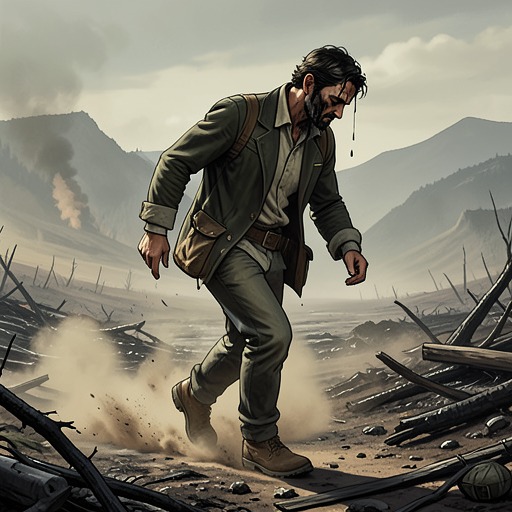
Grief
Train DreamsGrief is the defining emotional condition of Robert Grainier’s adult life, first created by the destruction of his family in the 1920 Moyea Valley fire and then sustained by uncertainty, memory, and repeated encounters with death. It does not remain a private feeling: it governs where he lives, what he searches for, how he interprets the burned landscape, and how he gradually converts an impossible hope of recovery into a solitary but workable existence.
The Fire and the Birth of Mourning
In the summer of 1920, Robert returned from the Robinson Gorge job with four hundred dollars in his pocket and found the Moyea Valley consumed by fire. The passenger journey ended at Coeur d’Alene, followed by a wagon ride through the Idaho Panhandle, and the smoke thickened as he approached Bonners Ferry. The town was crowded with refugees from along the Moyea River, many of them stripped of their homes and reduced to scattered possessions such as dolls, mirrors, and bridles. Robert searched among roughly one hundred people at the fairgrounds, questioning survivors about Gladys Grainier and their daughter Kate, but nobody had news of them.
The refugees’ relief at having escaped intensified his isolation. Their happiness was understandable, yet Robert was disturbed by their apparent lack of concern for those who might not have survived. The fire had divided the living from the missing without providing him a body, a witnessed death, or a final word. He therefore grieved within an unresolved space: he understood that his wife and little girl were probably gone, but could not entirely stop imagining that they had escaped.
He walked twenty miles along the Moyea River Road toward the homesite, tying a handkerchief over his nose and mouth and wetting it in the river to filter the smoke. Meadow Creek stood deserted, and the forest had become a field of charred spears. At the homesite, the cabin had vanished so completely that he could barely identify its former position; only the buckled cookstove and a few chimney stones remained. He called “Kate! Gladys!” repeatedly while moving through ash, smoke, and the still-warm aftermath of the fire. Mourning here is also an act of witnessing: Robert insists on reaching the place where his family disappeared even when the landscape has already erased nearly every physical sign of them.
Hope, Repetition, and the Ruined Home
After learning that no escapees had reached Creston, Robert stayed for several weeks at his cousin’s home. He was sickened by grief and confused by competing convictions. At times he accepted that Gladys and Kate had been lost; at other times the thought that they had survived stormed into his mind with such force that he felt obliged to search for them everywhere. Nightmares repeated the catastrophe in altered form: Gladys emerged from a blackened landscape carrying Kate, found nothing at the homesite, and stood crying in the waste.
Thirty days after the fire, Robert rented two horses and a wagon, loaded it with supplies, and set out to build shelter on his acre and wait through the winter for his family’s return. The plan was impractical, but its very enactment brought a painful recognition. Driving through ash deep enough to conceal the roadbed, and through a waste in which only the fastest animals or those with wings could have escaped, he felt his sorrow become “blackened and purified.” The journey burned away the hopeful thinking that had allowed him to imagine a reunion. Unable to breathe in the reek, he abandoned the project and returned to town.
The loss nevertheless drew him back. By the following May, new growth had appeared in the burned ground, including morel mushrooms and flowers, and Robert camped beside the river, fishing and living on dried mushrooms and trout cooked in butter. He moved northward until he came close to the old homesite, approaching it by the draw through which he and Gladys had once gone to the water. Rebirth in the valley did not cancel his grief; instead, the returning plants gave the ruined place a new, unsettling life in which absence remained visible.
At the camp he experienced visions and sensations connected with Gladys and Kate. He imagined Gladys’s chocolates, bought in a red box and divided so that mother and child could eat one each week; when he looked directly at the white paper cups he thought he saw scattered around him, they disappeared. He later saw what seemed to be Gladys’s white bonnet sailing overhead. He stayed for weeks partly in the hope that more impossible visions would come. He began talking to himself and repeatedly sighed, “A pretty mean circumstance!” The phrase gives his mourning a plain, almost practical verbal form: grief is too large to explain, so it returns as a short judgment about the conditions of life.
The Dead Who Surround Him
Robert’s grief is sharpened and interpreted by other deaths. As a boy, he encountered William Coswell Haley, a dying, injured boomer hidden among birches near the Kootenai River. Haley identified himself as a murdered man, said that Big-Ear Al had robbed him of fourteen dollars and cut the cords behind his knee, and asked Robert to carry the information to the sheriff. When Haley finally requested water, Robert brought it in the dying man’s old shoe and left him alone. He told nobody—not the sheriff, not his cousin Suzanne, and not anyone else. The episode becomes an early failure of witnessing, a silence that contrasts with the later persistence of his own attempts to find and name the dead.
Arn Peeples’s death offers a different pattern. Peeples seemed likely to die in an explosion after entering a tunnel to deal with a dud dynamite charge, having first placed his brass watch, tin comb, and silver toothpick on a stump. Instead, a dead branch from a tall larch struck him across the head. He became dizzy, feverish, dreamy, and forgetful before dying in bed with the covers raised under his chin. The captain imagined lowering him into a grave “bed and all,” while Billy remembered that Peeples had never cheated or stolen from anyone. The camp’s mourning is communal but constrained: the men discuss the cause of his delirium, say prayers, and then return to work because the company and wartime demand for spruce allow no extended pause.
The influenza crisis that follows Peeples’s burial spreads grief through the labor camp. Harold, the captain’s twelve-year-old son, collapses in front of the horses and is saved from being trampled when Robert pulls him away by his trouser leg. Billy then develops chills and raves through the night, astonishing the men who had known him as nearly wordless. Six more workers become ill, and the captain closes the job, gives each man a four-dollar bonus, and orders them to leave. His fear is rooted in personal history: in the 1897 influenza outbreak, he had been orphaned when all thirteen of his siblings died in one week. Robert pities the captain, recognizing grief hidden beneath authority and practical command.
Kootenai Bob’s death beneath the trains makes mourning more fragmented and materially difficult. In 1930, during the United States’ Prohibition, Bob was persuaded by visitors from British Columbia to drink shandy, then consumed an eight-quart pan of beer after the lemonade had disappeared. He lost the power of speech, wandered a mile up the tracks, and lay unconscious across the ties. Four or five trains passed over him, scattering him along a quarter mile of right-of-way. His people later collected the remnants of flesh, bone, and cloth that the crows had missed, placing them in painted leather pouches for burial. The scene presents grief as an effort to gather what violence has dispersed, giving ritual form to remains that industrial machinery has rendered almost unrecognizable.
Gladys’s Return and the Form of Memory
During Robert’s second winter in the new cabin, a dream of the train passing northward left him terrified and unable to sleep. The cabin had by then acquired windows, a proper roof, two benches, a table, and a barrel stove; Robert and the red dog still slept on a pallet on the floor, but the place had become as much a home as the one he had shared with Gladys and Kate. In that darkness, the completed shelter seems to call Gladys back.
The red dog senses the visitation before Robert sees it. Her hair rises, and a quavering illumination gathers in the room until the shape of a woman appears. Gladys is unmistakable yet unstable, flickering “like a figure in a motion picture.” She does not speak. Instead, Robert receives her grief as a silent communication: she cannot rest because she has not found her daughter, while Kate remains in the world of the living, alone in the burned forest.
The vision reconstructs Gladys’s death. As the fire approached, she discarded clothing and valuables while carrying the baby, a Bible, and the red box of chocolates. To steady herself on the rocky bluff, she threw away the Bible rather than the candy. She then slipped, broke her back on the rocks twenty feet above the water, and could no longer move her legs. She freed the child from her clothing, and the water eventually lifted and drowned her. The revelation gives Robert a concrete account of what had previously been an unconfirmed loss, but it does not resolve his mourning. Instead, grief becomes a shared, repeating condition between the living Robert and the dead Gladys, both unable to reach Kate.
Survival, Solitude, and the Unnoticed End
Robert’s mourning eventually becomes a rhythm rather than a dramatic recovery. He returns to the Moyea Valley with a wagonload of supplies, raises his canvas lean-to, and chops five dozen burned spruce for a future house. Animals come back before people do: bears leave tracks along the muddy road, butterflies rise from bear sign, and huckleberries begin returning to the blackened hillsides. Rebuilding therefore occurs beside ecological regeneration, not as a replacement for the lost family but as a way of inhabiting the altered world.
His later life follows seasonal repetitions—summers working in Washington, spring and fall at his cabin, winters boarding in Bonners Ferry. He forms attachments to animals, first to a little red-haired female dog and later to a large northern sled dog who remains his friend for many years. These companions do not erase bereavement, but they interrupt absolute isolation and alter his behavior: he stops speaking to himself because he is ashamed of being overheard by the dog. Grief remains present as a condition of daily life, moderated by work, animals, food, weather, and the return of the seasons.
Robert himself dies in a manner that echoes the unattended deaths he has witnessed. He lives past eighty, owns one acre, two horses, and a wagon, has never been drunk, and leaves no heirs. When he dies in his sleep sometime in November 1968, almost everyone in the region knows who he was, yet nobody misses him. His body remains in the cabin through fall and winter until two hikers find it in spring. With a doctor, they dig a grave in the yard using a shovel left beside the cabin. The burial is practical and minimally witnessed, but it gives him a place among the land he repeatedly tried to reclaim.
Grief thus governs the book’s movement between catastrophe and continuation. It is initially an urgent search for Gladys Grainier and Kate, then a discipline of returning to ruins, then a series of visions and encounters through which Robert learns that death may be dispersed, hidden, delayed, or forgotten. His final solitude does not provide a conventional resolution. Instead, the unnoticed death in the rebuilt cabin completes a pattern in which survival means carrying loss forward without ever fully converting it into closure.